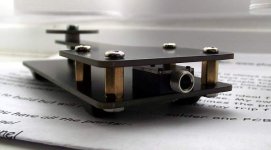
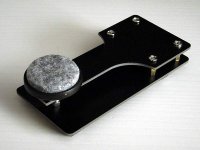
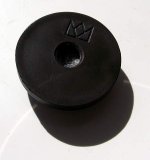
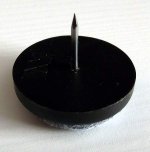
Well, about one week after ordering the kit it arrived!
I actually ordered two but have only built the one key up.
The key kit is packed in to two grip lock bags, one contains all of the assorted hardware, the other bag has the two PCB key parts, the base and the arm.
The base and arm are amazingly solid little items, looks like FR4 PCB material so very strong. For rigidity both the arm and the base PCBs use almost 100% copper coverage, with only the minimal amount removed for isolation between tracks.
You have to solder a small 3.5mm socket, and also a capacitor that I presume is to debounce the contacts. Simple idea but it works really well.
The only tools required (apart from a soldering iron) are a small Philips screwdriver, and either some small spanners or maybe an adjustable wrench. You can of course use some pliers, but be careful not to 'chew up' the brass separator posts.
The whole assembly including soldering took about 45 minutes taking it steady and not rushing (also I was taking some photographs along the way so that slowed things down a little).
The kit comes supplied with a red spacer washer, which if you prefer a larger contact gap you may fit. Actually mine had two of these washers in the parts bag. Once the key is assembled you try it out and see if you need a bigger gap. I found that even just gently resting my finger tips on the key made it close, so I inserted the spacer washer. Perfect!
Because there were two spacer washers in the bag I though I would see how it felt fitting both. Bad idea. Even though the spacers are fairly thin I found that with two fitted the gap was too much and took conscious effort to manipulate the key, and just seemed way too large. When reduced back to just one spacer all was excellent again.

For what it is, and how cheap they cost, the key feels great, and works really well.
There is no connecting lead supplied, but any 3,5mm audio lead will work (I have some here that were two for ?1 and they perform great with it). Because the lead is pluggable it's possible to carry a few spare leads just in case, or maybe have differing terminations on them, say 3.5 to 3.5, then maybe 3.5 to 6.25mm etc.
I'm not joking when I say that I really enjoyed building the key, and was really pleased with the end results! I tested it out using a Datong Morse Tutor as a practice oscillator, mainly because I know that the Datong is NOT very forgiving of contact resistance, so poor contacts on a key will generally result in a broken or wavering tone. There was none of that with this key!
It keys well (trust me, I have over 350 other keys to compare it to!), and would say it 'feels' a little like a cross between a 'strap' key (which is what it is essentially), and an old time high speed telegraph key.
So to sum up, a great little key, very solid in design, nice and slim so easily carried for portable use. For the price I think it's really good value, and well worth the money.
The only slight niggle for me is the screw head that sits proud of the control 'button'. Maybe a countersunk screw would be better (so that the head would be flush with the button surface), or else perhaps some kind of cover to round off the top of the button and add some grip for the operators' fingers. (I have an idea for this which I will try out and post on if it works out OK).
73, Mark...